

Beta Deep research is available wherever AI agents and Documents are enabled, including eligible AI trials. Reports are published as Documents, so the
documents feature flag must be on. Self-hosted deployments need the same Enterprise Edition license and AI provider configuration required by AI agents, and must add documents to LIGHTDASH_ENABLE_FEATURE_FLAGS. What Beta means.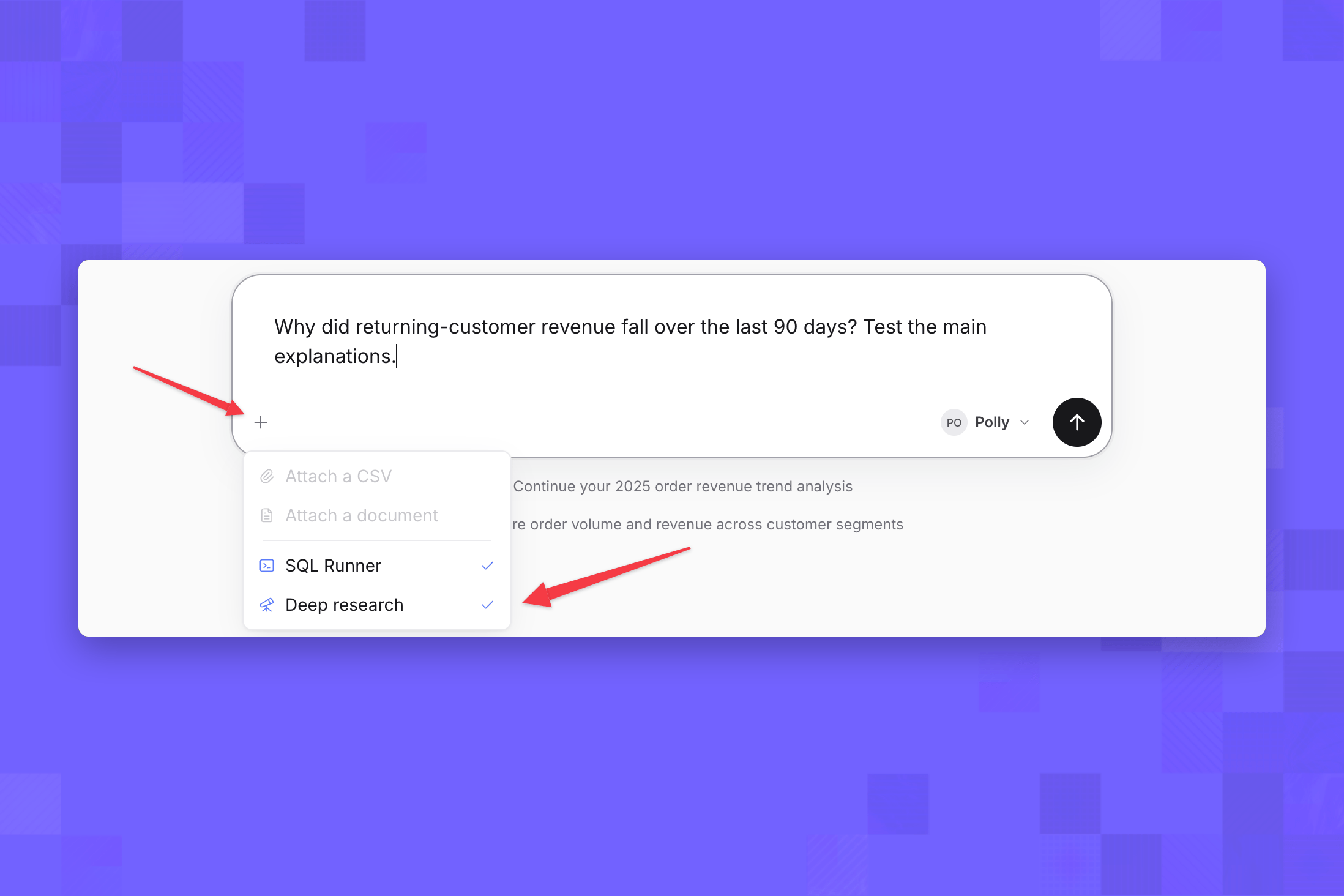
When to use deep research
Choose deep research for multi-step investigations that need cross-checking, several data cuts, or a report you can save and revisit. Stay in the default Ask mode for a quick lookup, one chart, or an interactive conversation where you want to steer each follow-up. Questions that work well include:- “Which product categories are trending down this quarter, and what is driving the change?”
- “Why did returning-customer revenue fall over the last 90 days? Test the main explanations.”
- “Compare paid and organic acquisition quality across our top three regions.”
How it works
Deep research uses the selected AI agent’s configuration, including its instructions, semantic-layer access, knowledge documents, project and repository context, and enabled tools. It automatically inherits the organization’s research limits and every MCP server attached to the agent; there is no per-run depth or source selection. Lightdash retries transient MCP discovery and provider timeouts with a bounded backoff. If an attached MCP server remains unavailable, the run preserves completed evidence and continues with healthy MCP servers and built-in tools where possible. For each run, a coordinator owns the investigation: it gathers context, queries the data, and decides what to pursue next. When a question is genuinely separable it can hand that question to an isolated data worker, up to two per run. A worker sees only its own task and warehouse tools, and returns a compact findings packet rather than raw results. The coordinator does not write the report. When research ends, Lightdash rebuilds what the run established from the queries it actually ran and their results, and the report is written from that evidence. This keeps the report grounded in verified executions and means a run that stops early still reports what it found. Because the run executes on the server, you can close the tab or leave the thread. Reopening the thread restores the run card and its latest state.Start a run
1
Open Ask AI
Use the Ask AI composer on the homepage, start a new agent thread, or open an existing thread that you own. Deep research is unavailable in read-only threads, such as another user’s thread or a thread started in Slack.
2
Enable Deep research
Select + in the composer, then select Deep research. A checkmark shows the mode is active, and the send button starts research instead of sending a chat message. CSV and document attachments are unavailable while the mode is on. When you type a longer investigative question, the + button can pulse to suggest this mode; you can still continue in regular chat.
3
Describe the outcome you need
Include the decision or question, relevant time period, important segments, and any definitions or constraints the agent should preserve.
4
Start the investigation
Submit the question. Lightdash saves it in the thread, creates a durable run, and begins processing it in the background.
Organization-wide settings and limits
When AI agents and thedocuments feature flag are enabled, organization admins can go to Organization settings → Ask AI → Deep research to configure the safety limits inherited by every run:
- Maximum steps — model steps the coordinator may take before it must finish
- Maximum tool calls — total tool calls across the coordinator and its workers
- Maximum warehouse queries — total semantic-layer and SQL queries across the run
- Time limit (ms) — wall-clock ceiling for the research phase
- Maximum tokens — total model tokens across the run
- Allow raw SQL — whether eligible users may use native or MCP
run_sqltools during a run
Sources and permissions
Deep research can use:- Agent context and project data — the semantic layer, saved Lightdash content, knowledge documents, and other context configured on the selected agent, subject to its data access settings.
- Warehouse queries — semantic queries and, when the agent and user are allowed to use it, SQL.
- Repository context — project context and source-code tools configured on the agent.
- MCP servers — every server attached to the agent and its enabled tools.
Follow progress
The run card stays next to the question that started it and shows the latest phase, elapsed time, warehouse-query count, finding count, and recent activity.Queued
Queued
Lightdash accepted the run and is waiting for a background worker to start it.
Running
Running
The agent is gathering context, querying the data, or writing the report. Select View activity to inspect recent progress.
Completed
Completed
The report is published as a personal Document and linked from the run card.
Partially completed
Partially completed
The run reached a resource limit or recoverable error. Lightdash still wrote the report from the evidence gathered before it stopped. Select Resume research to continue unfinished work from the preserved evidence without rerunning successful queries.
Failed
Failed
The run could not produce or publish a valid report. If it preserved usable evidence, select Resume research to continue unfinished work. Otherwise, the run card provides guidance to start over.
Cancelled
Cancelled
The creator stopped the run before it finished.
Read the report
Select the Document card on a completed or partially completed run. The report opens in the side panel; use the open link to view it full page. The report is a personal Document: only you and organization admins can see it until you save it to a Space. Use Save to Space to share it with others.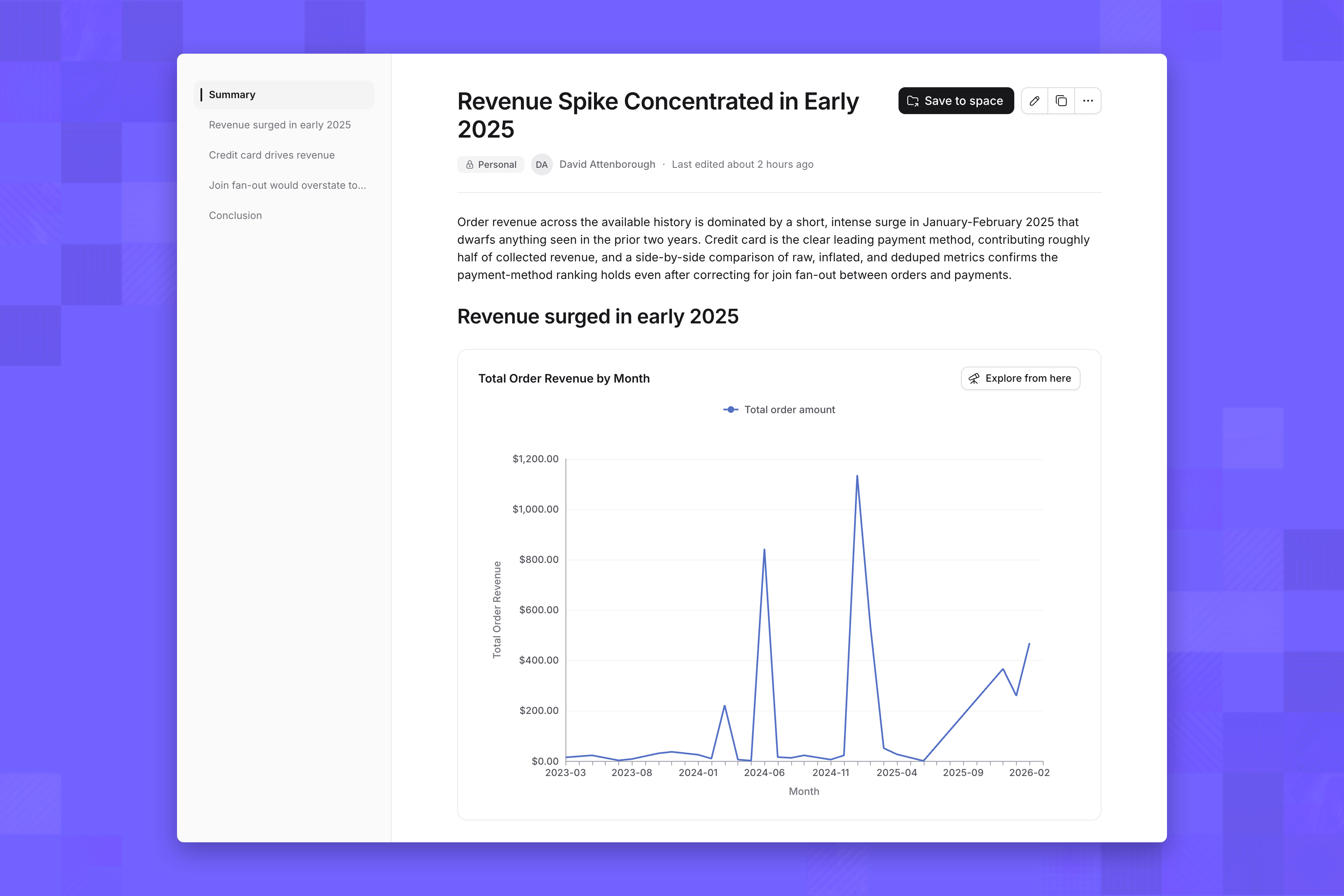
- A short introduction
- Finding sections led by verified charts, followed by concise supporting narrative
- A conclusion and inline caveats where data coverage, freshness, or the semantic layer limits the conclusion
- Links to external evidence when the report uses it
Report charts
Every report chart is a standard Document chart built from one verified warehouse query the run actually executed. It runs live against the warehouse, so it shows current data, and you can edit or explore it like any other chart in a Document.Keeping reports
A published report is an ordinary Document: it does not expire, and deleting or retrying the run does not affect it. Delete or move it like any other Document. Reports from runs that finished before Documents publishing stay available in their thread for 30 days after the run completed. The regular chat agent can use the status and report from deep research runs in the same conversation when answering follow-up questions. Ask it to clarify a finding, compare evidence, or explain a limitation without pasting the report back into the chat.Get better reports
- State the decision you are trying to make, not only the metric you want to inspect.
- Define ambiguous terms such as active customer, conversion, or retention.
- Include the time range and comparison period.
- Name segments the agent must test, such as channel, region, plan, or product category.
- Ask it to test alternatives or contradictions instead of assuming one cause.
- Treat a partially completed report as a starting point. Resolve unavailable sources or tighten the question before running it again; ask an organization admin to review the limits if runs repeatedly exhaust them.
Access requirements
Your organization must have the AI Agents entitlement or an eligible trial, thedocuments feature flag enabled, and Enable AI features for users turned on in Organization settings → Ask AI → General. Self-hosted deployments must also configure an AI provider as described in AI agents.
On Lightdash Cloud, ask your Lightdash contact to turn on Documents for your organization. Self-hosted deployments must add documents to LIGHTDASH_ENABLE_FEATURE_FLAGS. The older ai-deep-research flag has no effect.
Starting a run requires the Enterprise Start Deep Research runs scope (create:AiDeepResearch) for the project. Developer and Admin roles receive this scope by default. Add it explicitly to any custom role that should be allowed to start runs.
Users can only read, retry, or cancel their own deep research runs, and only within threads they are allowed to access.