

Beta Enterprise Agent permissions are behind the
agent-identity feature flag. On Lightdash Cloud, ask Lightdash support to turn it on for your organization. On a self-hosted instance, enable the flag. What Beta means.Choose what agents can do
Agent permissions are in the Permissions section of Organization settings → Agents, after the Identity section. Under What agents can do, choose one of three:
A Current badge marks the saved choice.
Read and query does not make SQL read-only. Raw SQL runs with the warehouse permissions of the identity that agents run as, so limit writes in the warehouse. See Agent identity.
Custom
Custom shows one switch for each capability, in three groups. Developer and admin opens when you select it.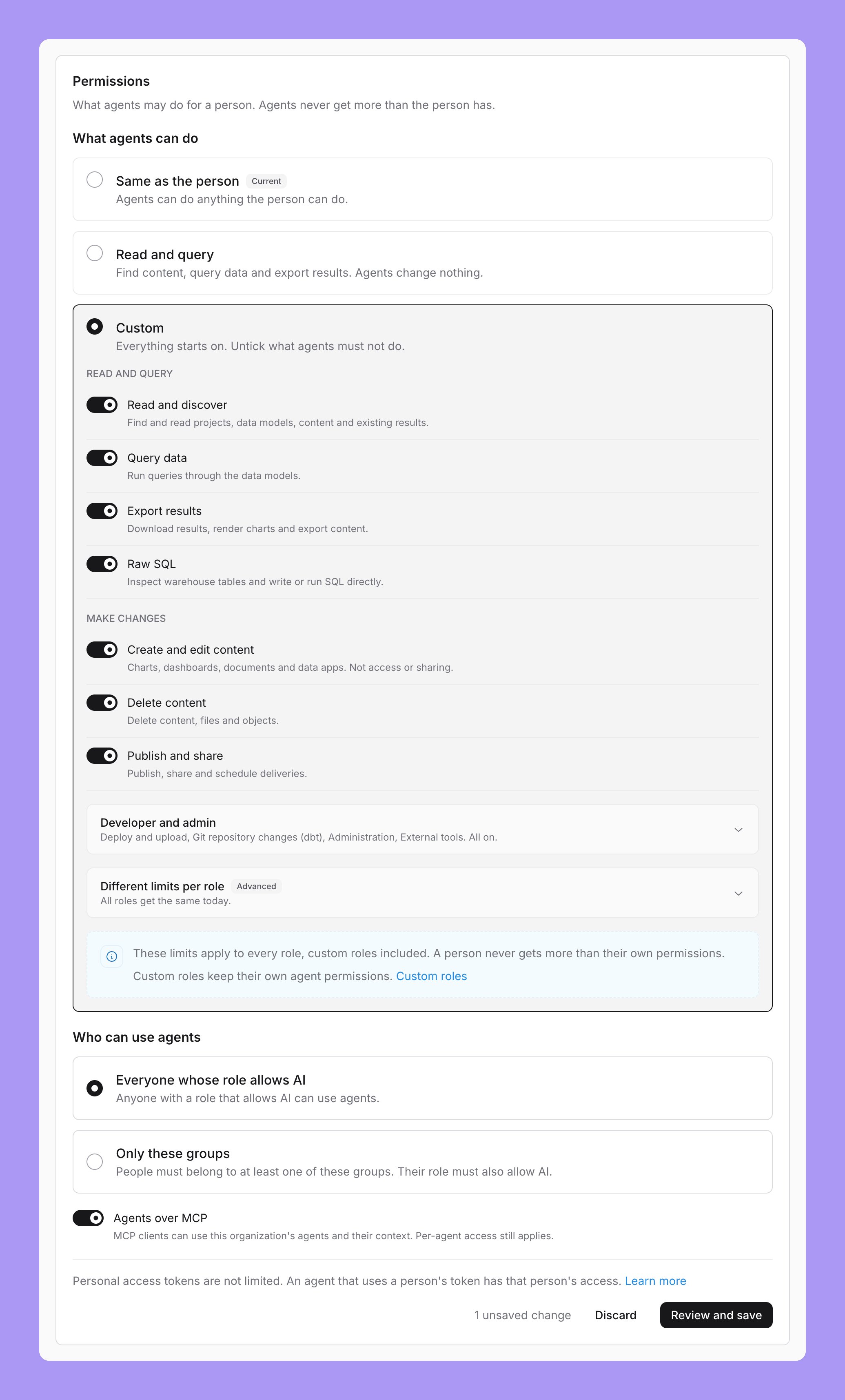
- A switch applies to every role. When you untick a capability, no agent can use it, whatever the person’s role. This includes people with a custom role.
- Unticking everything turns agents off. The page says “Agents are turned off for everyone.” No one can use Ask AI, the Slack agent, MCP clients or the CLI. People can still do the work themselves.
- Different limits per role, marked Advanced, has a table with one row for each role and one column for each capability. Clear a box to stop a capability for that role only. This table can only narrow the switches: it cannot allow a capability that is unticked. A person gets a capability when any one of their roles allows it.
Capabilities
An agent can do something only when the person’s own permissions allow it and the limits allow the capability. Refusals name the capability.Operations that need several capabilities
Some operations need more than one capability. Lightdash refuses the operation when any one of them is not allowed:
An agent that changes the Git repository needs Delete content only when its change deletes or renames a file. Lightdash checks the change before it commits or pushes anything.
Refusals
When the organization’s agent permissions block an action, the refusal says so, for example: “Your organization’s agent permissions do not allow Raw SQL. Ask an admin to change Permissions on the Agents page.” When the person’s own roles block it, the refusal says: “Your roles do not allow” followed by the capability, and asks them to have an admin review their permissions. An action can fail more than one check. Lightdash stops at the first check that fails, and the first line of the refusal names it. In the in-app chat and in MCP clients, the refusal then lists everything else that blocks the action:- Also needed names the other blockers, for example: “Also needed: Publish and share”. A blocker is a capability from the table above, or another limit, such as “access to agents”.
- See why links to My agent identity.
Turn off Raw SQL for agents
Raw SQL lets an agent list warehouse tables and run SQL outside the data models. An agent can use it when the person’s own permissions allow raw SQL and the limits allow Raw SQL. A project needs no other setup. To turn it off for every agent, choose Custom, untick Raw SQL, then review and save. Agents then get the refusal “Your organization’s agent permissions do not allow Raw SQL.”Who can use agents
Under Who can use agents, choose:- Everyone whose role allows AI. Anyone with a role that allows AI can use agents.
- Only these groups. People must belong to at least one of the groups you choose. Their role must also allow AI. Only members of these groups can use Ask AI, the Slack agent, MCP clients and the CLI.
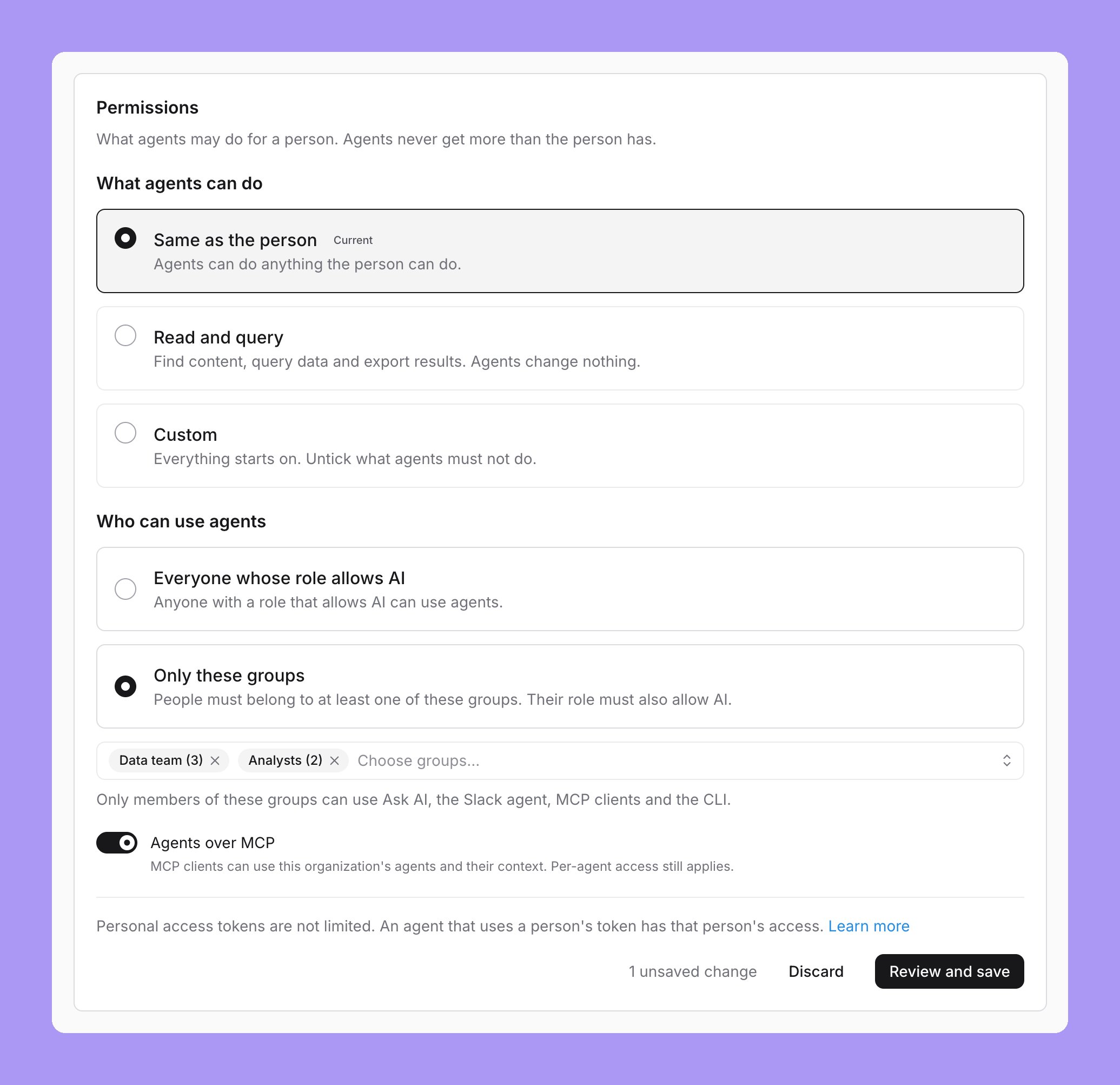
- The Who can use agents row shows only when groups are available to your organization.
- Only these groups needs at least one group.
- When every group you chose is deleted, the page warns “No one can use agents. All chosen groups are deleted.” Choose other groups, or Everyone whose role allows AI.
Review and save
Changes under What agents can do and Who can use agents are not saved one at a time. The page counts them, for example “4 unsaved changes”. Discard goes back to the saved state.1
Select Review and save
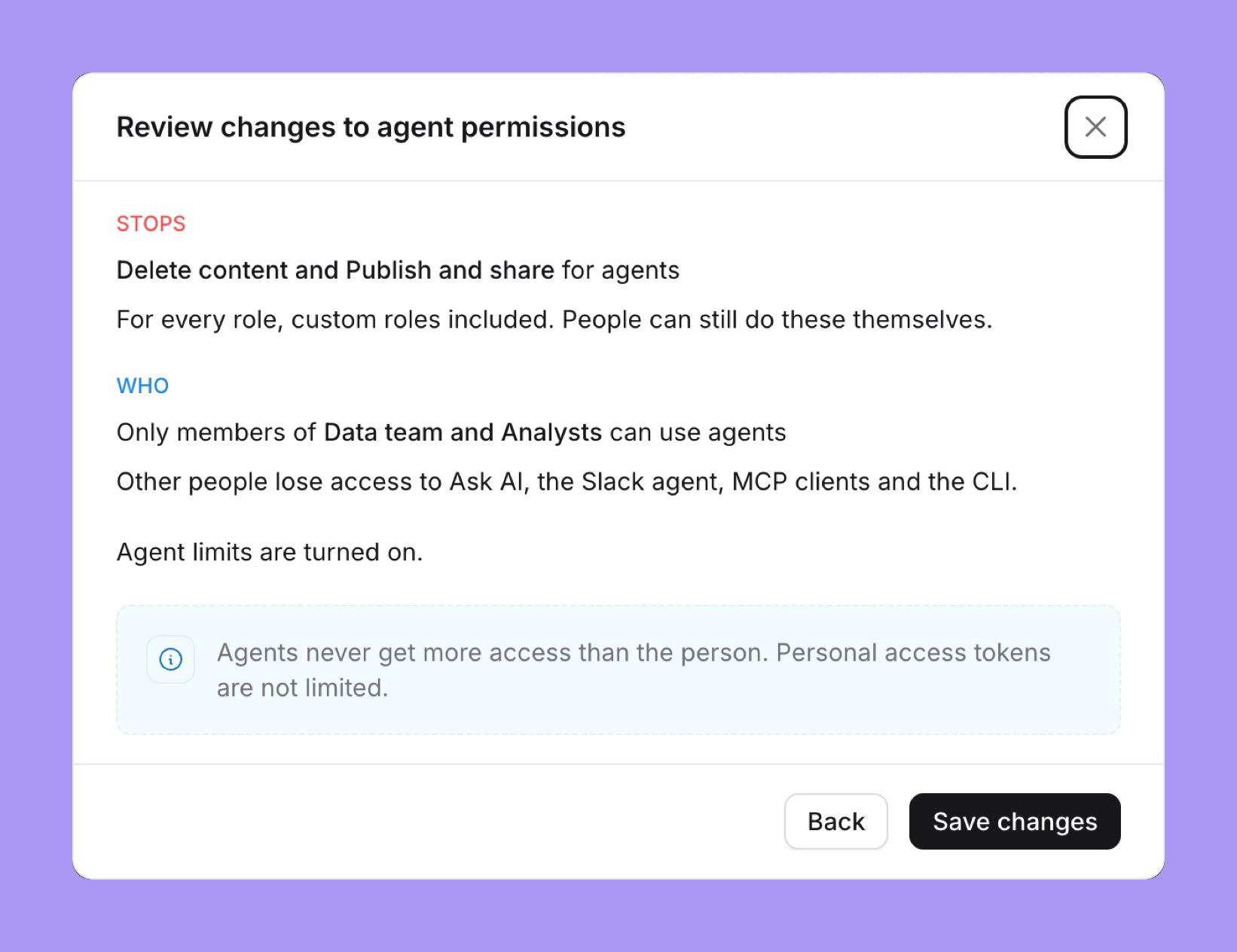
The Review changes to agent permissions dialog opens.
2
Read the review
STOPS lists what agents can no longer do, ALLOWS lists what they can do again, and WHO says who can use agents. When every capability is unticked, it says “Agents are turned off for everyone”.
3
Save
Select Save changes. Back returns to the page and keeps your changes.
Agents over MCP
The Agents over MCP switch lets MCP clients use the organization’s agents and their context. It is about MCP only: turning it off does not stop Ask AI or the Slack agent. To turn agents off everywhere, choose Custom and untick every capability.- The switch saves at once. It is not part of Review and save.
- It shows only to people who can change the setting.
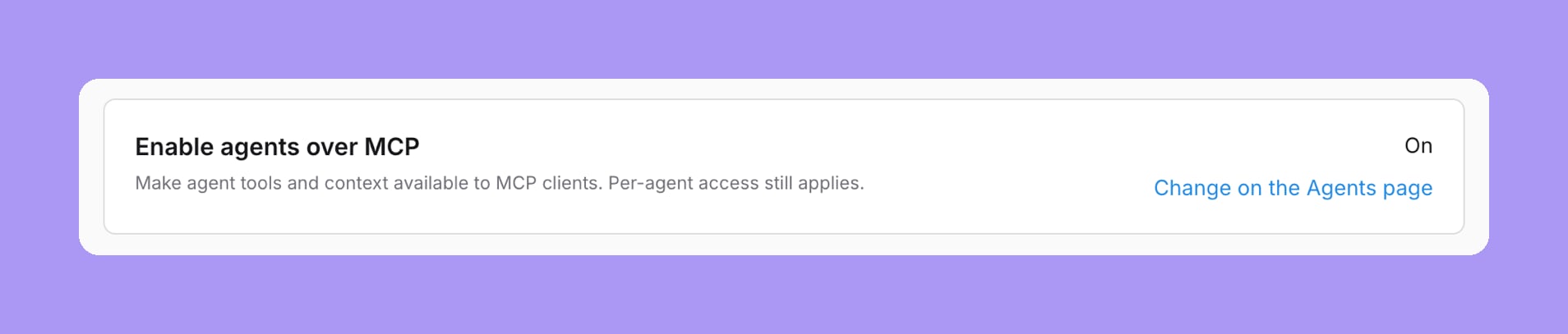
- For these people, Settings → MCP → General shows Enable agents over MCP as On or Off, with a Change on the Agents page link.
- Allow content changes via MCP stays on Settings → MCP → General.
Custom roles
Enterprise Custom roles have an Agent permissions group in the AI Features section of the role editor, with the 11 capabilities above. A new custom role starts with Read and discover, Query data, Export results and Raw SQL on. Custom roles keep their own agent permissions. The organization’s choice under What agents can do can only narrow them: an agent of a person with a custom role gets what the role allows, without the capabilities that the organization unticked.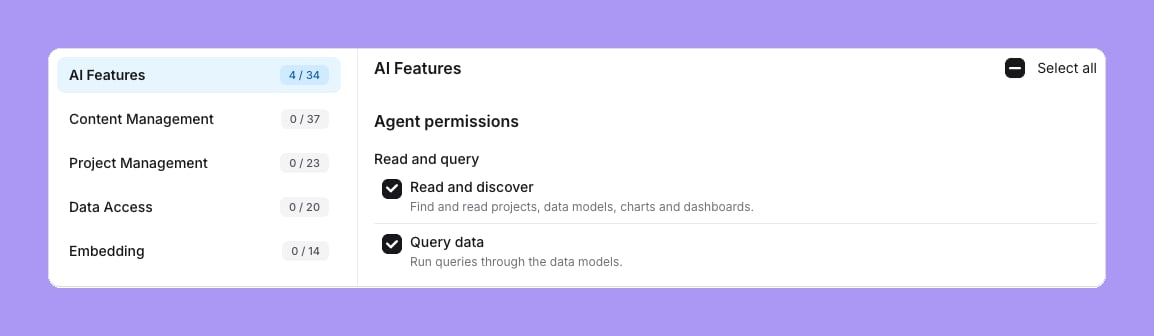
When you take agent access away
Lightdash reads agent access when it checks a request. It does not copy the access into a token. So a change applies at the next check, not at a fixed time. A request that has already passed its checks can finish. This applies when:- An admin deactivates a person.
- A person loses a role, or a custom role loses a capability. The capability stays when another role of the person still allows it.
- An admin unticks a capability, or unticks every capability to turn agents off.
- An admin removes a group from Who can use agents, or a person leaves every group that is allowed.
Work that is queued or running
Some agent work runs after the person asked for it. This work checks the person again when it starts, and again before it delivers or publishes. When a check refuses, the later steps do not happen. What the work has already published stays.
Lightdash checks at these points, not all the time. A step that has passed its check can finish, also when it takes long.
What a change does not cover
- Personal access tokens and service account tokens. Agent permissions do not limit them. A narrower limit does not narrow what a client does with one of these tokens. See Personal access tokens.
- A person’s ordinary role. A change to a person’s role can take up to about 30 seconds to apply to a browser session or a token. The agent permission check itself has no delay.
- Tokens that the warehouse has issued. Lightdash does not ask the warehouse to revoke a token that the warehouse has already issued. The warehouse decides how long that token is valid. Work that already has a warehouse connection can finish.
Reserved for people
With Read and query or Custom, agents cannot do some operations, whatever is ticked. Allowing Administration does not change this:- Change roles, groups, and project or space access.
- Manage custom roles, service accounts, personal access tokens, invite links and OAuth clients.
- Change the agent permissions or the agent identity rules.
- Change feature flag overrides.
- Get the Google Drive access token.
- Change the AI organization settings.